Skip to content
Top-rated outdoor gear, ranked

Best Of 2026

Best Hunting Hearing Protection of 2026

Our top 11 picks, independently ranked. Budget to premium.

A single unsuppressed shot from a 12 gauge or a magnum rifle lands somewhere around 150 to 160 decibels at the ear. That is well past the threshold where damage happens instantly, not gradually, which is why so many hunters over 50 ask people to repeat themselves in a crowded room. The cruel part is that the shots we take least often, the ones that actually matter, are the ones we are least likely to be wearing protection for. Nobody sits in a treestand from dark to dark wearing foam plugs, and nobody swings on a rooster while cupping their ears.

That is the real problem electronic hearing protection solves. Modern units amplify quiet ambient sound (a buck's footsteps in dry leaves, a rooster flushing behind you, your buddy calling the shot) while clamping down on the muzzle blast in well under a hundredth of a second. You end up hearing more than you would with naked ears, not less, and the gunshot still gets cut. For big game that means keeping directional awareness on approach. For waterfowl it means hearing the whistle of wings over a blind full of shouting people. For upland it means catching a flush in heavy cover without a muff hanging up your gun mount.

The market splits cleanly into two shapes and three price bands. Over-ear muffs give you the highest attenuation for the money and are the honest starting point for anyone shooting a shotgun in a blind or a magnum rifle off a bench, though the cup can fight a proper stock weld. In-ear units disappear under a hat, never interfere with the gun mount, and are the format most serious hunters migrate to once they have the budget. Below $70 you are buying protection with usable amplification. Between $120 and $370 you are buying better sound quality, faster recovery after the shot, real weather sealing, and controls you can work in gloves. Above $900 you are in true hearing-device territory, where the unit is programmed to your ears and the specific frequencies of your quarry, and where you should expect an audiologist to be part of the purchase.

At a glance

#ProductPrice
1$130–$160
2$110–$170
3
Impact Sport (R-01526)

Howard Leight by Honeywell

$40–$70
4$300–$370
5$30–$50
6$120–$150
7$150–$200
8$150–$200
9$1,800–$1,900
10
Phantom

SoundGear

$1,500–$1,800
11$12–$25
PELTOR Sport Tactical 500
Best OverallMid-range

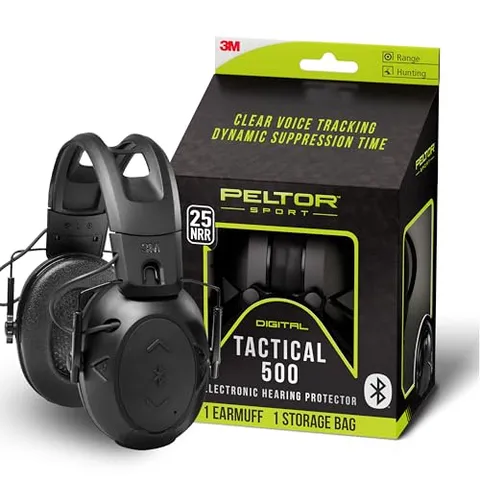
1. PELTOR Sport Tactical 500

3M

$130–$160

The most complete package for a hunter who wants one set of muffs to cover the stand, the blind, and the range. Clear Voice Tracking makes conversation intelligible in wind, and the recovery after a shot is fast enough that a second bird is still audible.

Best for: The hunter who wants one durable, high-protection muff for rifle season and range work alike

26 dB NRR is the highest protection among mainstream electronic muffs at this price · Voice tracking circuitry keeps speech intelligible instead of just making everything louder · Rechargeable with strong runtime, plus Bluetooth for calls and audio · Large controls that work with gloves on

Ear cups are thicker than slim-profile competitors and can crowd a shotgun stock weld · Roughly triple the price of a serviceable budget muff

GS Extreme 2.0
Editor's PickMid-range

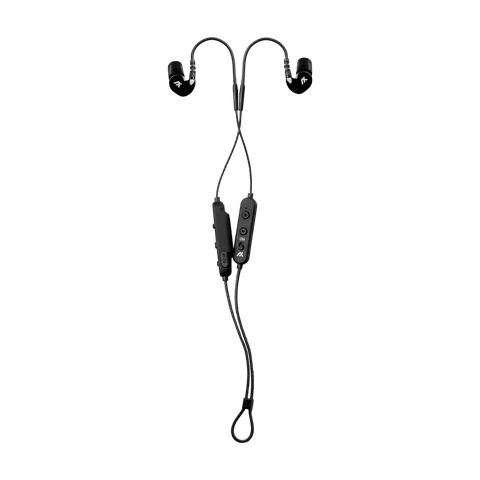
2. GS Extreme 2.0

AXIL

$110–$170

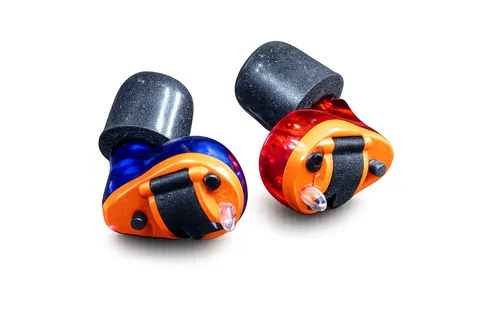
The in-ear unit that has become the default among shotgun hunters, because nothing sits between your cheek and the stock. Foam tips deliver up to 29 dB NRR while the electronics amplify ambient sound roughly six times.

Best for: Waterfowl and upland hunters who need a clean gun mount without giving up protection

Zero interference with a shotgun mount, which muffs cannot match · Up to 29 dB NRR with foam tips, higher than most electronic muffs · Roughly 12 hours of runtime in hearing mode with a long standby reserve · Doubles as Bluetooth earbuds for the drive in

The 29 dB figure only applies with foam tips, silicone drops it to about 22 dB · Small parts are easy to lose in a dark blind · Does not protect against bone conduction the way a muff partly does

Impact Sport (R-01526)
Best ValueBudget

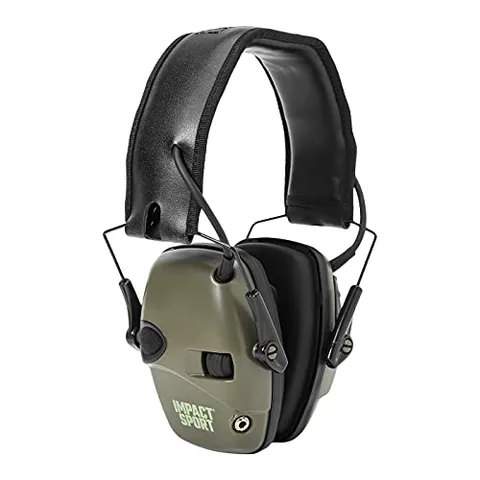
3. Impact Sport (R-01526)

Howard Leight by Honeywell

$40–$70

The muff that has been the entry point for a generation of shooters, and it still earns the spot. Genuinely slim cups, minimal wind noise, and a price low enough that outfitting the whole camp is not a real decision.

Best for: First-time buyers and anyone who needs several pairs for camp or for guests

Slimmest cups in the budget class, so a rifle stock weld stays reasonable · Notably low wind noise compared with other cheap muffs · Runs on AAA batteries you can replace anywhere, no charging required · Audio input jack for a radio

22 dB NRR is on the low side for a magnum rifle or an enclosed blind · The control wheel doubles as power and volume, which is awkward with gloves · Headband padding is thin over a long sit

Supreme Pro-X
Best PremiumPremium

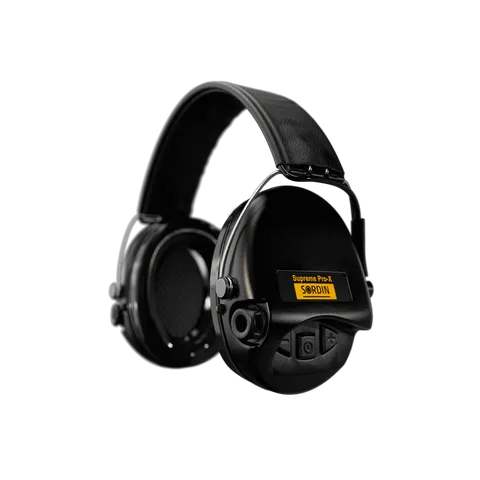
4. Supreme Pro-X

Sordin

$300–$370

The muff that professionals and serious European driven-hunt shooters keep buying, built in Sweden with a waterproof housing and a five-year warranty. Directional amplification is accurate enough that you can place a sound without turning your head.

Best for: The hunter who wears protection every day of the season and wants it to last a decade

Waterproof construction that genuinely survives a wet season · Best-in-class directional sound reproduction for locating game by ear · Slim cups plus gel seals, comfortable over an all-day sit · Five-year warranty and long battery life on standard AAA cells

21 dB NRR is modest for the price, this is a comfort and clarity purchase · Headband adjustment range is limited for larger heads · Battery compartment is fiddly with cold hands

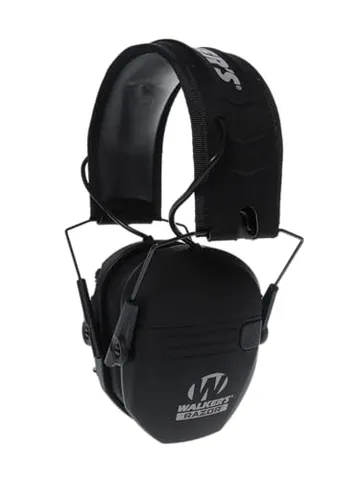
Razor Slim Electronic Muff (GWP-RSEM)
Best BudgetBudget

5. Razor Slim Electronic Muff (GWP-RSEM)

Walker's

$30–$50

The cheapest muff worth owning, and the ultra-low-profile cup is the reason. Sound-activated compression reacts in about 0.02 seconds, which is respectable for a unit that often sells under $40.

Best for: Hunters who want real electronic protection for the price of a box of shells

Lowest-profile cups of any budget muff, which helps on a rifle · 23 dB NRR, a step up from most sub-$50 competition · Folds flat for a pack, and sold in a wide range of camo and solid finishes · Simple two-knob control layout

Microphones pick up meaningful wind noise on an exposed stand · Build quality reflects the price and hard use shortens its life · Runs on AAA cells that drain if you leave it powered on

Sport ADVANCE BT
Mid-range

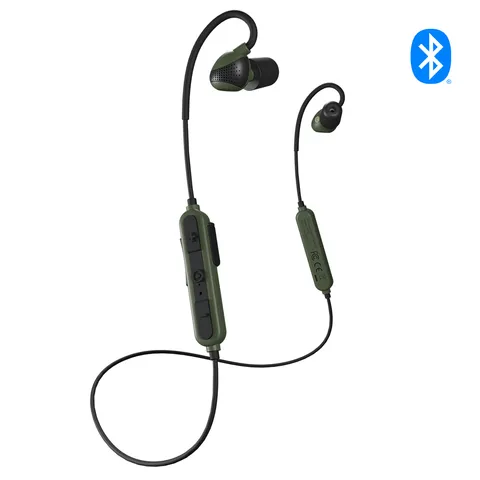
6. Sport ADVANCE BT

ISOtunes

$120–$150

The most weather-proof in-ear option at a sane price, with an IP67 rating that matters in a flooded timber hole or a rainy November stand. Tactical Sound Control suppresses anything above 85 dB while keeping quiet sound audible.

Best for: Waterfowlers and wet-weather hunters who need in-ear protection that shrugs off water

IP67 sealing, the strongest weather rating in the mid tier · 26 dB NRR from passive isolation before the electronics do anything · Around 10 hours of runtime and a large, easy control surface · Works equally well for chainsaw and shop use in the off season

Foam tips rebound quickly and need reseating through the day · Some owners report intrusive low-battery beeping · Fit is fussier than a muff and takes practice to get right

XCOR Pro
Mid-range

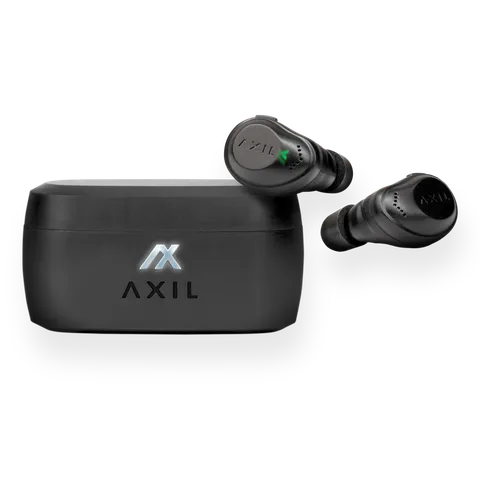
7. XCOR Pro

AXIL

$150–$200

A true-wireless design with a charging case, so it behaves like the earbuds you already carry while doing the protection job. The low-profile fit is secure enough to survive crawling through cattails.

Best for: Mobile hunters who want protection that behaves like everyday wireless earbuds

Secure, genuinely low-profile fit that stays put through movement · Charging case gives multiple full recharges away from power · Multiple tip sizes included, so most ears can find a seal · Dust and water resistant, with wind-resistant microphones

21 to 23 dB NRR is lower than the foam-tipped GS Extreme · Costs more than the GS Extreme while protecting slightly less · Touch controls can misfire with wet or gloved hands

Silencer BT 2.0
Mid-range

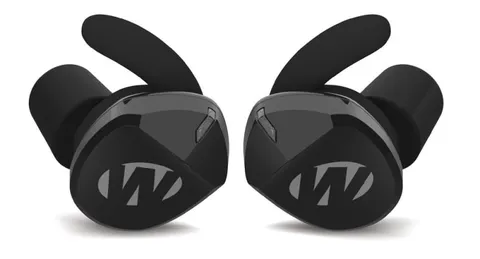
8. Silencer BT 2.0

Walker's

$150–$200

Walker's has been building in-ear digital protection longer than most, and the BT 2.0 adds app control so you can tune amplification and mode without pulling a bud out. A solid 24 dB rating in a package that disappears under a beanie.

Best for: Hunters who want app-adjustable in-ear protection from a widely available brand

Free companion app allows full tuning from a phone · 24 dB NRR in a fully in-ear package · Rechargeable with a compact dock, no loose batteries to lose · Widely stocked, so replacements and tips are easy to find

Sound quality trails the ISOtunes and AXIL units at similar money · Charging contacts can be finicky if they get dirty · No formal ingress rating for heavy rain

Multi-Pursuit AlphaShield 2
Premium

9. Multi-Pursuit AlphaShield 2

TETRA Hearing

$1,800–$1,900

Developed by audiologists who hunt, with six switchable programs (Deer, Elk, Turkey, Waterfowl, Upland, Range) that enhance the specific frequency bands each pursuit depends on. This is the only unit here designed around what you are listening for, not just how loud it is.

Best for: The serious multi-season hunter who wants enhancement tuned to deer, ducks, and roosters alike

Six pursuit-specific programs, switchable with a tap in the field · Frequency enhancement tuned to game sounds rather than flat amplification · Battery life measured in days rather than hours (10 to 16 days) · Fits without a custom ear impression, with silicone and memory-foam tip options

Costs more than most rifles, and single-pursuit models still start around $900 · 21 dB NRR is modest given the price · Buying involves a hearing consultation rather than a click

Phantom
Premium

10. Phantom

SoundGear

$1,500–$1,800

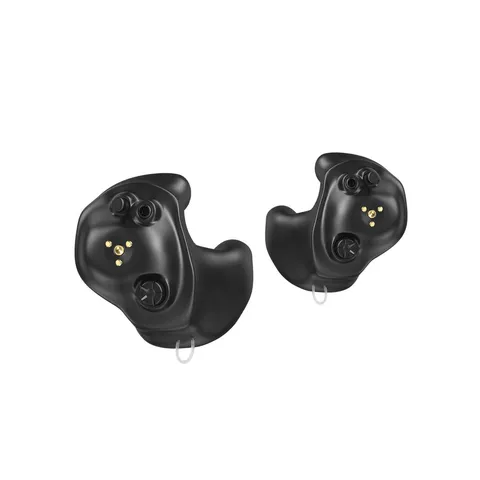
A custom-molded device that is a genuine hearing aid and a hearing protector at once, which is the right answer for hunters who already have measurable loss. Roughly 23 hours per charge and direct Bluetooth to a phone.

Best for: Hunters with existing hearing loss who want one device that both corrects and protects

Corrects existing hearing loss while protecting, rather than just amplifying · Custom mold means a seal you cannot get from a universal tip · About 23 hours of runtime on a charge, enough for a full day plus a long drive · Streams calls and audio directly from a phone

Around $1,599 before the custom earmold, which is an additional cost · Requires an in-person fitting and impression, so no same-week purchase · Overkill for a hunter with normal hearing

EP4 Sonic Defenders Plus
Budget

11. EP4 Sonic Defenders Plus

SureFire

$12–$25

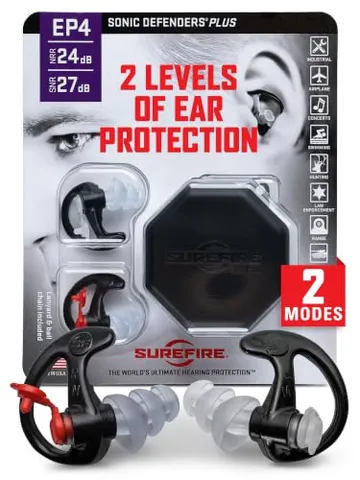
No batteries, no charging, and cheap enough to keep a pair in every pack, blind bag, and truck console. The filtered stem passes normal conversation while attenuating impulse noise, and the removable plug caps convert them to full 24 dB protection.

Best for: A backup pair that lives in every pack, and for hunters who refuse to manage batteries

Nothing to charge or fail, which makes them the ideal backup pair · Filtered open stem lets you hear conversation and game movement · Caps in gives up to 24 dB NRR, caps out gives about 12 dB · Reusable, washable, and available in three sizes

No amplification, so situational awareness is worse than any electronic unit · Attenuation with the caps out is too low for sustained shotgun volleys · The small caps are very easy to lose in the field

How we choose

We ranked by what a hunter actually gets in the field, not by spec sheet totals: how fast the compression circuit recovers after a shot so you are not deaf to a second bird, how much wind noise the microphones generate on an exposed ridge or an open water spread, whether the shape allows a clean stock weld with a shotgun, battery life across a multi-day trip, and how the thing holds up to rain, sweat, and being crushed in a blind bag. Sources include hands-on testing coverage from Outdoor Life and NRA Shooting Sports USA, manufacturer specifications from 3M, Sordin, AXIL, ISOtunes, TETRA, and SoundGear, and retailer listings used to establish realistic current street pricing. Budget picks (roughly $12 to $70) buy protection plus basic amplification and are chosen for reliability at the price rather than fidelity. Mid tier ($110 to $200) is where sound quality, weather resistance, and low-profile fit become genuinely good, and it is where most hunters should shop. Premium ($300 and up) covers rugged professional-grade muffs and, at the top, prescription-grade in-ear devices tuned to your own audiogram. Nobody paid for placement here. Retailer links may earn a commission, and that has no influence on which products appear or how they rank.

Common questions

Yes. Noise-induced hearing loss from gunfire is not cumulative in the way that industrial noise is. A single impulse above roughly 140 dB can destroy hair cells in the inner ear permanently, and hunting arms routinely exceed that by 15 to 20 dB. Most hunters who have lost high-frequency hearing did it a shot at a time over decades, each one feeling harmless. The ringing that fades by dinner is not proof that nothing happened.

It depends mostly on what you shoot and how. Muffs give more attenuation per dollar and are easier to put on and take off, which suits a rifle hunter sitting still or anyone shooting at a range. The cup interferes with a shotgun stock weld, though, so waterfowlers and upland hunters usually end up preferring in-ear units, which vanish under a hat and never touch the gun. If you can only own one and you hunt with a shotgun, buy in-ear.

For hunting, an NRR in the low to mid 20s is plenty, and chasing the highest number available is often counterproductive. NRR is a laboratory rating measured under continuous noise, and real-world attenuation is typically well below the printed figure because fit is imperfect. What matters more for a hunter is how well the electronics amplify safe sound and how quickly they recover after a shot. A 22 dB unit you actually wear all day beats a 30 dB unit sitting in your pack because you could not hear anything with it on.

No. A well-suppressed subsonic .300 Blackout can land in genuinely hearing-safe territory, but that is the exception. A suppressed centerfire rifle firing supersonic ammunition still produces a sonic crack, and most suppressed hunting rifles come in somewhere in the 130s at the shooter's ear, which is still capable of doing damage. Treat a suppressor as a large reduction in exposure rather than as a substitute for wearing something.

Some will and most will not. Sub-$70 muffs generally carry no meaningful ingress rating and the microphone ports are an obvious entry point for water. If you hunt over water or in consistent rain, look specifically for a sealed rating (the IP67 on the ISOtunes ADVANCE, for example) or for a muff built to a waterproof standard like the Sordin Supreme Pro-X. Otherwise plan on the unit being a two or three season item and budget accordingly.

For most hunters, no. A $130 to $200 unit covers the safety requirement and delivers good amplification. The $900 and up devices from TETRA and SoundGear are worth considering in two situations: you already have measurable hearing loss and want a device that corrects your specific audiogram while protecting you, or you hunt hard enough that programmed frequency enhancement for a particular quarry genuinely changes your success rate. Both usually involve a hearing professional, which is part of what you are paying for.

Some links are affiliate links, and we may earn a commission at no extra cost to you. It never affects our rankings.

In your pocket

Take the whole unit with you.

Free, no account needed. Public-land maps, field reports, and GPS tracking in your pocket.

  • Every outfitter and lodge in your pocket

  • Public-land boundaries with no subscription

  • Field reports from hunters out there now

  • GPS tracking that keeps recording deep in the backcountry

The Hunting Hubs app dashboard

For operators

Run your hunting operation?
Launch your branded surface.

Get your own branded surface in the Hunting Hubs app and a directory listing in minutes. bookings, digital waivers, and your whole operation in one cockpit.