Food plots fail for boring reasons: the wrong seed in the wrong month, at the wrong rate, in soil nobody tested. None of it is mysterious, and all of it is fixable, but a lot of what's written about food plots gets the basic agronomy backwards, so start with the two facts everything else hangs on.
First: Is a Food Plot Even Legal Where You Hunt?
Nobody tells you this, and it matters.
A standing crop planted as a normal agricultural practice is generally exempt from baiting regulations, that's the legal foundation food plots rest on. But it is not universal:
- Some states go further than others, and a handful ban baiting and supplemental feeding outright, which changes what you can legally do around a plot even when the plot itself is fine.
- Public land is a separate question. Michigan, for one, prohibits constructing or maintaining any food plot to attract wildlife on public land, whatever the baiting rules say.
- CWD management zones layer on their own feeding and baiting bans, and those change county by county, sometimes mid-season.
- The difference between a legal plot and illegal bait can be as simple as whether the crop is growing or piled.
Check your state's current regulations, and check the CWD zone map, before you buy seed. A club that plants an illegal plot has bought itself a citation, not a hunting spot.
Second: The Seasonal Split, Correctly
Here's the one that trips up half the food-plot content on the internet.
Clover, chicory and alfalfa are COOL-season perennials. Not warm-season. Not "late season." They green up in spring, feed deer hard through spring and fall, and go dormant in the cold.
The crops that actually carry deer through November to February are brassicas and cereal grains.
| Category | Crops | What they're for |
|---|---|---|
| Cool-season perennials | White/ladino clover, red clover, chicory, alfalfa | Spring and fall nutrition; the permanent base of your plot program |
| Cool-season annuals | Brassicas (turnip, radish, rape), cereal rye, oats, wheat | The hunting-season and winter plot. This is your late-season food |
| Warm-season annuals | Soybeans, cowpeas, corn, lablab, sorghum | Summer nutrition, antler growth and lactating does. Gone by November |
Plant clover expecting it to hold deer in December and you will be sitting over dormant forage while the neighbours shoot deer over turnips.
Soil: Test It, and Lime It Early
Get a soil test before you buy a single bag of seed. Your extension service runs them for $15–30 and turns them around in a week or two.
Target pH 6.0–7.0 for most forage. (Brassicas actually want it higher, 6.5 to 7.5. The crop that genuinely tolerates acid soil is cereal rye, which is one of several reasons it's the most forgiving thing you can plant.)
Lime takes months to move pH, often six to twelve. This is the single most important scheduling fact in food plotting. Test in late winter so you have the whole spring to correct, and lime well ahead of planting. Lime applied the week you plant does nothing for that crop.
Seeding Rates: Where Most Plots Are Lost
Over-seeding is the most common and most expensive mistake, and it's the one that costs you bulbs.
| Crop | Broadcast rate (lb/acre) |
|---|---|
| Brassica blend | 5–8 (turnip alone 1.5–2; rape 3.5–4; kale 3.5–4) |
| White / ladino clover | 4–6 |
| Red clover | 8–12 |
| Crimson clover | 15–25 |
| Chicory | 3–5 |
| Cereal rye / wheat / oats | 50–100 |
Two rules to go with that table:
Broadcast rates run about 1.5× drilled rates. A drill puts seed at consistent depth with good soil contact, so you can use less. Broadcasting wastes seed by definition. Plan for it.
Brassicas do not "thin themselves." Over-seeding brassicas is the number-one cause of a plot that grows leafy tops and never makes a bulb, which is the entire reason you planted them. Resist the urge to add "a little extra for insurance." You are buying yourself a failure.
Fertiliser: The Legume Rule
Legumes fix their own nitrogen. Do not fertilise clover, peas or beans with much nitrogen. More than about 40 lb N/acre just feeds the grass and weeds that then out-compete your clover. What legumes need instead is inoculant, the right rhizobia on the seed, which is cheap, essential, and almost never mentioned.
Brassicas are the opposite: heavy nitrogen feeders. They want roughly 75–100 lb N/acre. Plant brassicas without nitrogen and you get a thin, low-tonnage crop that underdelivers all season.
Everything else (phosphorus, potassium, lime), comes off your soil test. That's what the test is for.
Timing
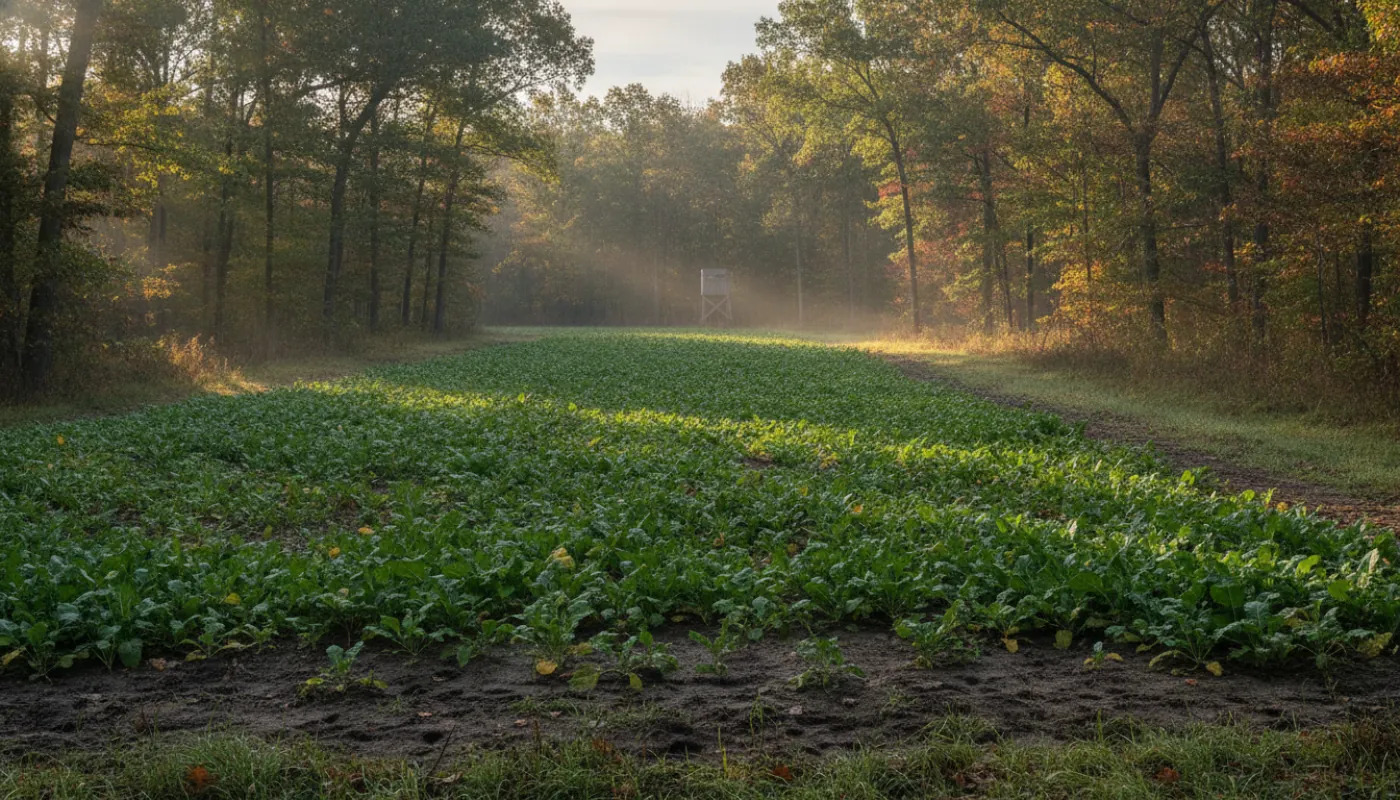
Brassicas need 60 to 90 days before your average first frost, about 60 for good tops, 90 if you want bulbs. That's roughly double the window most guides give. (They take 60–90 days to mature, and are grazing-ready around 65–75; the old "30–45 days" figure is simply wrong.)
In practice:
- Upper Midwest: plant brassicas roughly 20 July to 10 August. Late August is already too late up there, a fact that surprises people every single year.
- Further south, the window slides later.
The failure mode isn't that brassica seed won't germinate in cool soil; it germinates fine. It's that the plant never builds enough biomass or bulb to matter. You get a token stand and no groceries.
Cool-season perennials (clover, chicory) go in spring, late March through May in most states, so they have 60–90 days to root before summer heat. Clover planted in July is wasted seed.
Frost seeding clover onto existing plots is done in late winter, February into early March, broadcasting onto freeze-thaw cycles that work the seed into the soil. Not November onto frozen ground.
Ground Prep
Kill the sod first. "Remove existing sod" is not a method. The standard is glyphosate, roughly 2 quarts per acre, at least three days before seeding. Existing grass will out-compete anything you plant and win.
Then work the ground, with the right implement. A rotary cutter (bush hog) is a mower. It cuts vegetation and does nothing whatsoever to a seedbed. What you need is a disk or tiller (or a no-till drill, if you've killed the sod and can borrow one). Renting a bush hog to "work it twice" gets you a neatly mown field and no seedbed at all.
Till two to three weeks ahead so the ground can settle, then broadcast or drill, then cultipack or roll to firm the seed-to-soil contact. Rolling is the cheapest yield increase available to you.
Don't try to irrigate a field-scale plot. Let the rain do it. Time your planting to a forecast instead.
How Much, and Where
The benchmark is 2–5% of your property in food plots, spread out rather than concentrated in one big field. Several small plots in different corners hold deer better and give you more huntable setups than one large one.
And don't plant a monoculture. Layer a perennial clover-and-chicory base for spring and fall, with annual brassicas and cereal rye for the hunting season and winter. Cereal rye deserves special mention: it is the most winter-hardy food plot crop in North America, it produces forage into spring long after brassicas are finished, and it tolerates poor, acidic soil better than any other cereal. Oats are the ones that winterkill in the north, not rye.
Maintenance
Clip perennial plots at least once in spring to knock back dead growth and weeds and let new shoots through. Skip it and you'll have a matted, unpalatable mess by November.
Walk your plots monthly during the season. Bare patches, browse lines, and untouched corners are all telling you something for next year. Write it down, the club that keeps notes outplants the club that keeps opinions.