Before you hang a single camera, one question that most trail-camera guides never ask: is it legal where you hunt?
Increasingly, the answer is no.
Check Your State First: This Is Not a Formality
Trail cameras have gone from unregulated gadget to actively restricted equipment in a growing list of states, and the restrictions land hardest on exactly the tactics hunters most want to use.
| State | Restriction |
|---|---|
| Arizona | Any trail camera, cellular or SD, may not be used to take, locate, or aid the take of wildlife. Statewide, public and private land, since 1 Jan 2022 |
| Utah | All trail cameras banned on public land 31 July – 31 Dec. Transmitting cameras prohibited for taking protected wildlife even on private land |
| Nevada | Trail cameras banned on public land 1 Aug – 31 Dec |
| Kansas | Cameras prohibited on all KDWP public lands and Walk-In Hunting Access areas |
| Idaho | Transmitting/cellular cameras banned on public land 30 Aug – 31 Dec for big game |
| Montana, Colorado, New Hampshire | Using same-day transmitted images to locate or take game is unlawful |
| Pennsylvania | Cameras allowed on State Game Lands, but baiting around a camera is illegal, and acting same-day on a texted photo is hunting with an unlawful electronic device |
| Delaware | Cameras banned for recreational use on state wildlife areas, forests and parks |
| Iowa | A ban on state-managed land has been in active rulemaking |
Read that list against the tactic every cellular-camera marketing page pushes: get an alert, move your stand, go kill him. In Montana, Colorado, New Hampshire and Pennsylvania that is a violation. In Arizona the camera itself is. This is not a grey area, and the fines are real.
The rules also move every year. Check your state agency's current regulations before the season, and check the specific rules for the unit you hunt, public land often has stricter rules than private.
With that settled, here's how to actually place one.
Height and Angle: Lower Than You Think
The single most common framing error is mounting at human eye level and aiming at your own face.
Mount at the deer's height, not yours. The National Deer Association's guidance is roughly knee height, about 21 inches above where the deer will actually be standing. A whitetail's head and back line sit around three to three and a half feet; your standing face is five to six. Aim at your own face and you have guaranteed yourself a season of photographs centred a foot above every deer that walks past.
To aim it, crouch to deer height, or better, use the camera's walk-test mode and cross the trail yourself at the height a deer would occupy.
Keep it near level. Bubble-level the camera with only a slight downward tilt. A steep 15–30° down-angle at chest height puts the centre of your frame in the dirt about eight feet away, which is nowhere near where the deer will be.
The exception worth knowing: mounting high (six to ten feet, angled down), is a legitimate concealment tactic, not a mistake. Auburn's deer research found mature bucks avoided cameras placed lower more than higher ones. If you're chasing a specific old buck, high-and-angled-down is the play; just accept you'll lose some antler detail.
Distance and the Detection Zone
Modern PIR sensors detect out to roughly 50 to 100 feet, with a 40–60° field of view, considerably further than most guides claim.
Set back 10 to 15 feet from the trail for a general placement. That's the NDA range, and it gives you a full-body frame without the animal blowing through the near edge of the detection zone. Placing a camera three to five feet off a trail, advice you'll see repeated, is far too close and produces exactly the blurred, half-a-deer frames you were trying to avoid.
Angle the camera 20–45° to the trail, not square across it. The spec that matters is trigger speed, the lag between the sensor firing and the image being captured, typically 0.1 to 1.5 seconds. A deer crossing a 90° camera can be gone before the shutter opens. Angling the camera down the trail keeps the animal in frame far longer and turns a miss into a sequence.
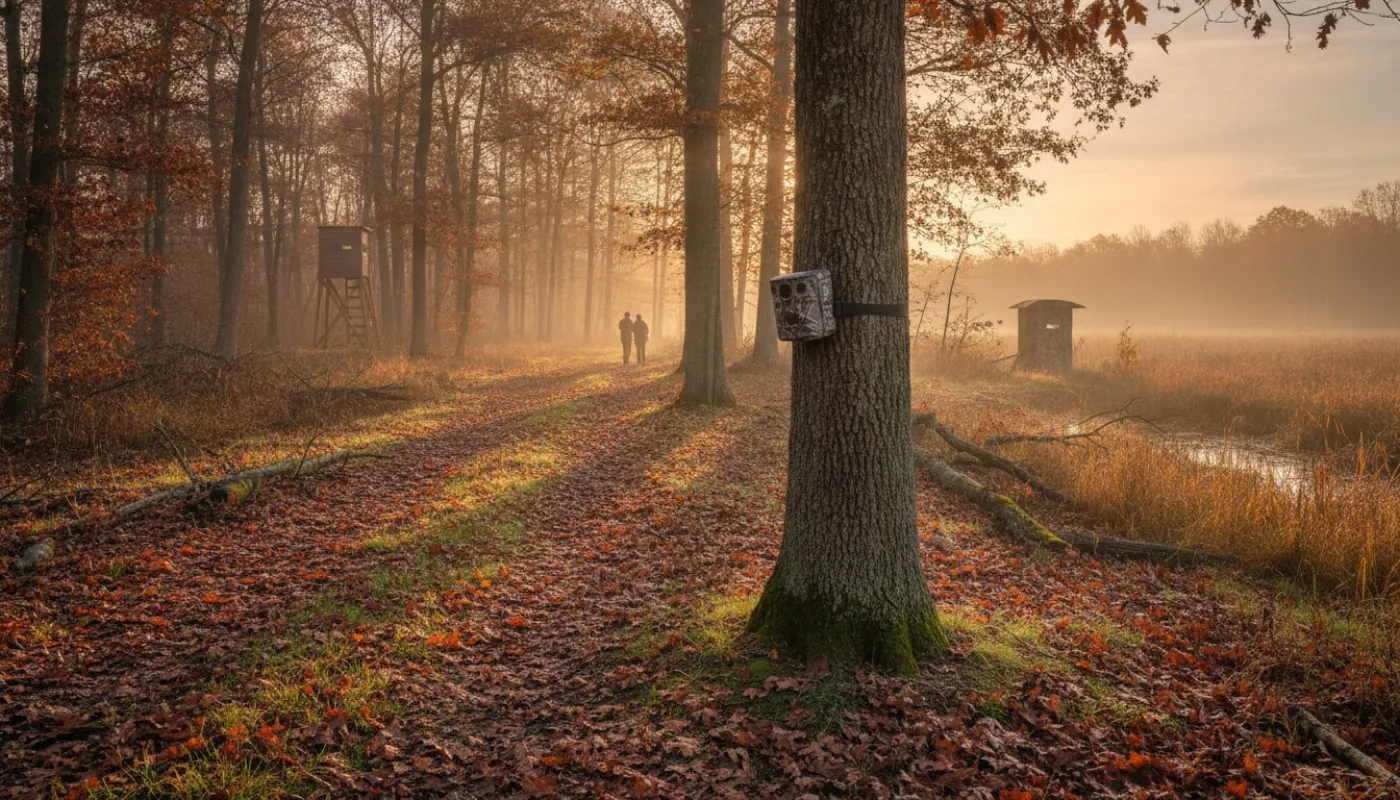
Point it north. This is the mistake almost nobody mentions: a camera facing east or west stares into the rising or setting sun, washing out precisely the dawn and dusk images you care about and firing constant false triggers as shadows move. Aim somewhere between northeast and northwest, due north if you can.
The Rut Is Not Always November
Early season, September into early October, hang cameras on food sources and the trails leading to them. Bucks are still predictable, still patterning, and you're building an inventory of who lives there.
Then the rut scrambles everything, and cameras move to doe bedding areas, scrapes and fresh rubs.
But be careful about "the November rut," because that phrase is only true for part of the country. November is peak breeding across the northern tier and mid-latitudes. Along the Gulf Coast and through the Deep South, breeding runs from October clear into February: parts of Alabama, Mississippi, Louisiana and Florida peak in January and February, and South Texas peaks in late December. If you hunt the South and move your cameras for a November rut, you have moved them for somebody else's season.
For scrape cameras: knee height, 10 to 15 feet back, facing north. Not "six feet downwind", a scrape camera isn't a stand, and the deer isn't going to smell your camera from downwind in any way that a north-facing lens changes.
The Discipline That Actually Matters: Stay Away
Here's the research finding that should reorganise how you run cameras:
Human intrusion, not the camera, is the dominant negative effect on deer behaviour. As the NDA's Kip Adams puts it, visiting a camera location too frequently will hurt you far more than running the cheapest camera on the market and checking it wisely.
Which makes the standard "swap batteries every six weeks, change cards monthly" advice actively counterproductive. Good lithium AAs will run a properly configured camera for an entire season, often six to twelve months. Every unnecessary trip in is scent, noise, and an education for a buck you're trying to keep relaxed.
Set it up right, and then leave it alone.
While we're demolishing folklore: "infrared" and "no-glow" are not synonyms. Low-glow (850nm) and no-glow (940nm) are both infrared; only 940nm is genuinely glow-free. And the categorical claim that you must always run no-glow over white flash isn't supported, the NDA reports that across hundreds of thousands of images, more deer reacted negatively to infrared cameras than to white flash. The lever that reliably works is fewer visits, not a wavelength.
Running an Actual Camera Survey
If you want data rather than snapshots (real density, buck-to-doe ratio, fawn recruitment, age structure), there is a published protocol, and it is worth doing:
- One camera per 100 acres. (On tracts over 1,000 acres, one per 160 acres is acceptable.)
- Run it 10 to 14 days. Mississippi State's research found 14 days captures roughly 90% of the unique deer using an area.
- Run it pre-season, after antlers harden, before acorns drop and deer disperse.
- Over bait, where bait is legal. This is the part that requires care: baiting is illegal in many states and on much public land (including Pennsylvania's State Game Lands), and CWD zones add their own feeding bans. If you cannot legally bait, run the survey over food plots or natural funnels and accept a longer survey window.
That gives your club numbers to manage against instead of arguments about whose buck is on whose card.
The Rest of the Mistakes
Clear the sight line. Grass and branches between lens and trail mean false triggers, a full card, and hours of footage of vegetation moving in the wind. Trim it, and re-trim it every spring.
Don't walk the trail you're watching. Approach from the side, ideally when it's wet, and never leave fresh tracks straight past a camera on snow or soft ground.
Check your card and battery discipline against the intrusion cost. A camera that dies in the first week of November taught you nothing, but so did a camera you visited nine times to prevent it.
Get the legal question right, hang it at knee height facing north, angle it down the trail, and then have the discipline to walk away from it for a month. That's most of it.