Every state sets its turkey season dates annually. Which means any article that hands you a date table is handing you something that will be wrong by next spring: including, if we published one, this one.
So this guide does something more useful and more durable. It teaches you the rules that don't change when the dates do: how seasons are structured, the shooting-hour traps that get hunters cited, the legal-implement rules that are near-universal, the reporting deadlines, and the safety discipline that turkey hunting demands and deer hunting doesn't.
Get your dates from your state agency. Get everything else here.
The Rules Behind the Dates
Season dates move, but the logic that produces them is stable, and knowing it tells you roughly when to plan.
Spring seasons open later as you go north, tracking breeding phenology. Mississippi opens in mid-March; Alabama's private land in late March; Louisiana in early April (not March, a common error, and only its youth weekend falls in March). Kentucky opens mid-April, codified as the Saturday closest to April 15, running 23 days. Ohio comes in late April, Pennsylvania in early May. New York, Vermont and Maine open around May 1 and run to the end of May (Maine into early June).
Note what that means for the Northeast: mid-May is the middle of those seasons, not the tail. If you've read that northern states "run into mid-May," you've been told they end when they're actually at their peak.
And the openers are deliberately late. Agencies have been pushing openers back so that most hens are already bred and incubating before hunting pressure starts. The logic is the opposite of the folk wisdom that seasons are timed to catch peak breeding.
One piece of biology to bin entirely: wild turkeys are not migratory. A bird's annual home range is on the order of a square mile or two. A gobbler on your lease in March has not "moved north" by April, he's within earshot of where he was. Staggered openers track latitude, not bird movement.
(And turkeys don't have a "rut," and hens are not "in estrus." Estrus is a mammalian term. Birds don't have one.)
The Trap That Gets People Cited: Half-Day Seasons
This is the single most important thing in this article, and most turkey content omits it entirely.
In many states, spring turkey hunting ends at noon. Not sunset. Noon.
| State | Shooting hours |
|---|---|
| New York, Vermont | Noon close for the entire May season |
| Pennsylvania | Noon close for roughly the first half of the spring season, all-day after |
| Ohio | Noon close for the first ~9 days of each zone, all-day after |
| Alabama, public land | Daylight to 1 p.m. |
An out-of-state hunter who assumes all-day hunting and sits until 3 p.m. in New York in May is hunting illegally, and doesn't know it. Confirm your shooting hours every single season, including whether they change partway through.
Legal Implements: What's Actually Restricted
The near-universal rules are the ones most guides skip:
Rifles are illegal for turkey in every state checked. Turkey is a shotgun-and-archery game bird.
Shot size is capped, and the cap varies: #2 or smaller in Louisiana, Mississippi, Alabama and Vermont; #4 or smaller in Kentucky; #2 through #9 in New York; #4 through #6 in Maine. Carrying the wrong shot is an easy, avoidable citation.
Semi-automatic shotguns are legal in many states (Pennsylvania allows them, with a three-shell limit), so if you've read that semi-autos are widely banned for turkey, that's the atypical example being presented as the rule.
Decoys are regulated too, and this catches people:
- Alabama bans mechanical decoys, including reaping/fanning devices, outright, and has restricted decoy use entirely in the early part of a season.
- Louisiana bans motorized decoys.
- Live decoys are banned in Louisiana, Ohio, Vermont and New York (and essentially everywhere).
Turkey Safety Is Different, and It Is Not Optional
Deer hunting safety is about your stand. Turkey hunting safety is about other hunters mistaking you for a turkey, and it is the one thing every club must brief.
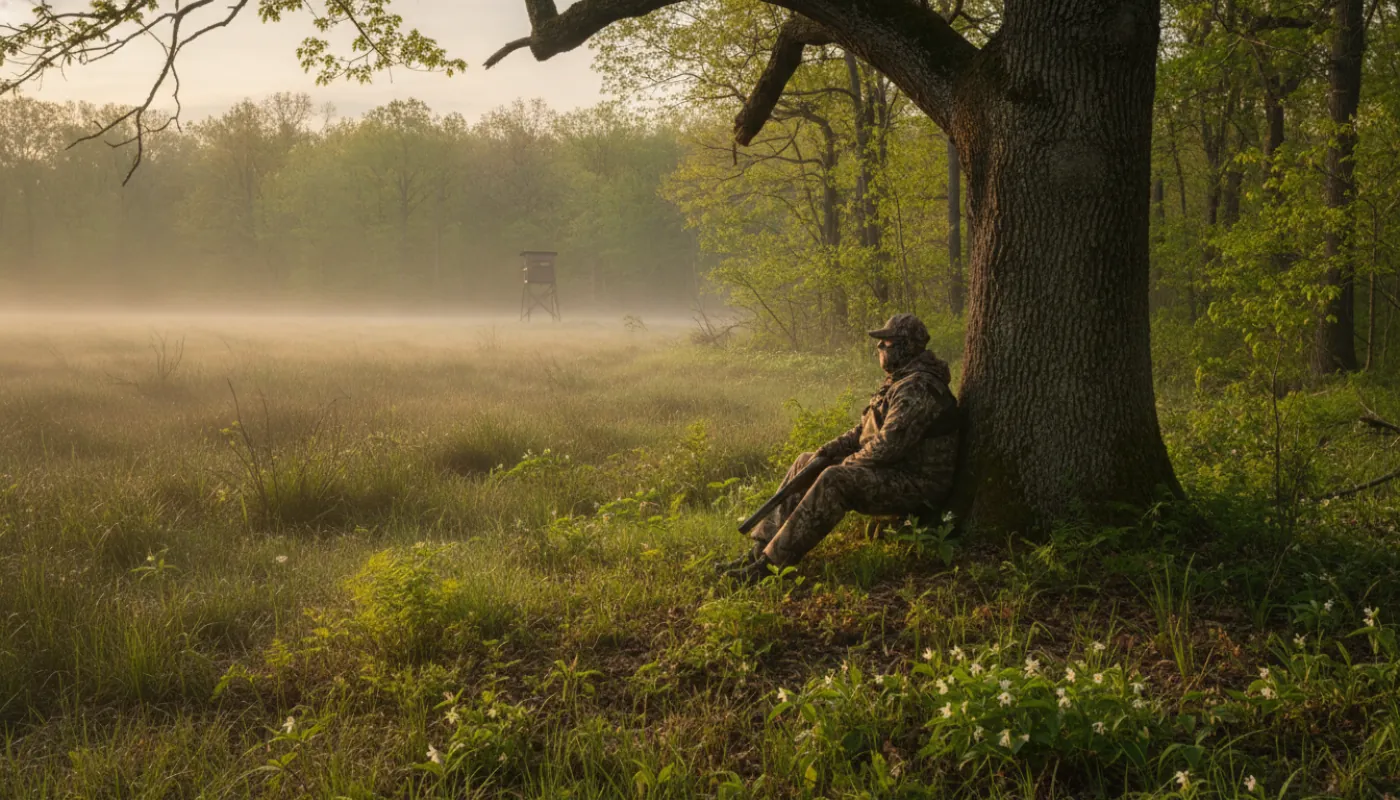
Never stalk a gobble. If you hear a turkey, the odds are meaningful that it's another hunter calling. Sit down, call, and let the bird come to you. Never wear red, white, or blue, those are precisely the colours of a gobbler's head. And when you set up, put your back against a tree wider than your shoulders.
This isn't advisory in every state, either: Pennsylvania makes stalking turkeys, or stalking turkey sounds, unlawful.
And note the tension with tactics: "reaping" or "fanning", crawling toward a bird behind a fan or decoy, is exactly the behaviour that gets hunters shot. Alabama has banned the devices outright. Think hard before you do it anywhere, and never on public land.
Tags, Licences, and the Paperwork
Most states are over-the-counter. Every state checked (Louisiana, Mississippi, Alabama, Pennsylvania, Ohio, Kentucky, Maine, Vermont, New York), sells turkey tags OTC for both spring and fall. Draws exist only as narrow exceptions (certain public-land or controlled hunts). If you've read that turkey tags are "often limited by draw" and you need to apply months ahead, that's inverted, you'll mostly just buy one.
Hunter education is mandatory in every state checked (birth-date-gated in Louisiana, Mississippi, Alabama and Kentucky). Sort it before you plan the trip.
Harvest reporting is mandatory, and the deadlines are short. This is a legal duty separate from tagging the bird, and it's where casual hunters slip up:
| State | Report by |
|---|---|
| Mississippi | Game Check, 10 p.m. the same day |
| Kentucky | Telecheck, by midnight |
| Ohio | Game check, 11:30 p.m. |
| Alabama | Game Check, 48 hours |
| New York, Vermont | 48 hours |
| Pennsylvania | 10 days |
Tag the bird before you move it. Then report it on time.
Spring Tactics
Roost them the night before. An owl or crow call at dusk will often pull a shock gobble and tell you exactly where the bird will be at daylight. Set up close in the dark, but not too close; 100–150 yards is plenty, and blundering into a roost tree ruins the morning.
Call less than you want to. Pressured birds get educated fast, and the most common mistake is over-calling. A few soft yelps, then long silence. Let him wonder.
Then be patient. The bird that hangs up and goes quiet has very often not left. More gobblers are killed by hunters who sat still for another forty minutes than by hunters who got up and moved.
Fall Is a Different Game
Fall turkeys aren't breeding, they're flocked, and the entire tactic changes.
The classic method is to scatter the flock, deliberately break it up so the birds separate, and then set up and call them back together with assembly yelps and kee-kee runs. The birds want to regroup; you're just offering the rendezvous.
Note the distinction that gets garbled constantly: owl, hawk and crow calls are spring locator calls that provoke a shock gobble. They are not a fall tactic. Fall calling works off a physical scatter, not a predator call.
Fall structures vary widely. Ohio's fall season runs only in October; Pennsylvania's doesn't open until late October; Kentucky's archery season runs from early September clear into January. "September through November" is not a reliable generalisation.
Your Pre-Season Checklist
Run this every year, per state, from the agency's own site:
- Season dates for my zone and my weapon.
- Shooting hours, and do they change mid-season? (The noon trap.)
- Bag limit, and whether it's per-season or per-day.
- Legal implements: shot size, magazine capacity, archery legality.
- Decoy rules, mechanical? reaping devices? live decoys?
- Hunter education, do I hold it, and is it accepted here?
- Harvest reporting deadline, and how do I file it from the field?
- Public vs private: different rules, different hours, sometimes different seasons.
Write the answers on one page. If you run a club, hand that page to every member, because when a member gets cited, it's the club that has to explain it to the landowner.
Anything on this list can change between now and next spring. The birds won't. The rules will.