A hunting lease is a business contract, and the season-ruining surprises are almost never about deer. They're about a clear-cut in October, a gas well access road in November, or discovering that the man who took your money didn't actually own the hunting rights.
Here are the ten questions, in the order that matters.
1. Do you actually own the hunting rights you're leasing me?
Start here, because everything else is wasted if the answer is no.
The person offering you a lease may not hold the rights they're selling. A tenant farmer cannot lease you hunting rights. Neither can a life-estate holder in some circumstances, or a surface lessee, and in many states hunting rights can be legally severed from the land and held by someone else entirely.
Ask to see the deed. Cross-check the owner of record against the person signing. If it's an LLC, a trust, or a family partnership, ask who has authority to bind it.
2. Do you reserve the right to harvest timber?
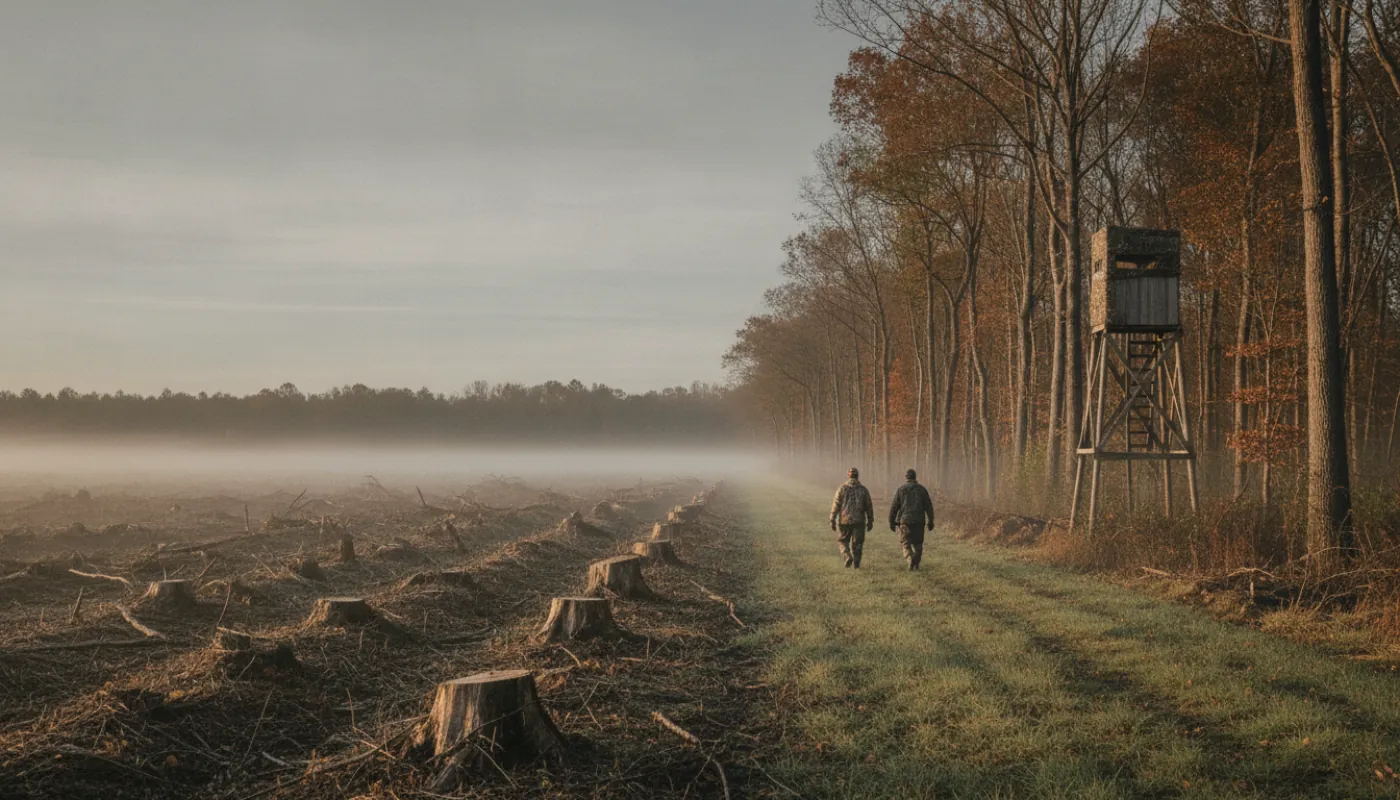
This is the classic hunting-lease horror story, and it is not rare.
Standard timber-company and landowner lease language reserves the lessor's right to cut "by selective cutting, clear cutting, or any other method as the lessor shall determine in its sole discretion", and typically adds that the lessor "is not responsible for deer stands or feeders damaged or destroyed by timber harvesting."
Read that again. You can pay for a season in August and watch skidders working your best ridge in October, with no refund and no recourse, and your stands broken.
So ask, specifically:
- Do you reserve timber rights? (Almost certainly yes.)
- Is any harvest planned or scheduled during my term?
- Will I get notice before a cut?
- Is there rent abatement or a termination right if you cut during hunting season?
A landowner who genuinely has no plans will happily put a notice clause in writing. One who won't is telling you something.
3. What else is reserved: minerals, grazing, farming?
The mineral estate is typically the dominant estate, most importantly in Texas, but the principle is widespread. That means a mineral lessee can put a well pad, an access road, and truck traffic on your lease in the middle of your season, and neither you nor the surface owner can stop them.
Also ask about agricultural operations: grazing, spraying, and harvest schedules. A cattle rotation through your best bottom, or an aerial spray during the rut, will change your season.
4. Exactly how many acres, and where are the lines?
You're paying per acre. Verify the acreage independently against the deed's legal description or the county appraisal record, not the landowner's estimate and not a hand-drawn map.
Then walk the boundary, or at least the corners. Ask how the lines are marked, and whether you're permitted to post signs.
5. Who else has access?
Ask, and get it in the lease:
- Is my lease exclusive? Can the landowner hunt, or bring guests?
- Are there other lessees: a separate turkey lease, a dog-hunting club, a timber crew?
- Are there public access easements, utility easements, or a right-of-way?
- Who else has a key to the gate?
"Exclusive" is a word worth paying extra for, and worth writing down.
6. What does the liability picture actually look like?
Here's where most lease guidance is flatly wrong, so be careful.
You, the lessee, buy the liability policy, and you name the landowner as an additional insured. That is the industry standard, not a fallback for when the landowner lacks coverage. Market-standard hunt-lease policies run $1M per occurrence / $2M aggregate, and they are cheap, a fraction of a dollar per acre, often a couple hundred dollars a year for a whole club.
Three corrections to advice you'll see elsewhere:
Don't ask the landowner to cover you. Their farm or ranch policy insures them, not you, and many farm policies specifically exclude paying hunters. Asking for their certificate and being told "yes, I have farm liability" is how hunters end up signing uninsured.
Don't assume your homeowners policy covers it. People say it "excludes hunting." That's not the real mechanism. Standard homeowners liability generally does cover your negligence off-premises, including an accidental shooting. The gap is the "premises you own, rent, or lease" exclusion, which signing a lease triggers precisely. So the uncovered events are the trip-and-fall, the cabin fire, the ATV wreck, the drowning, everything that happens on the tract you now lease.
And a waiver is not a red flag. Every agricultural-law extension program in the country tells landowners to get one signed. It's normal. What's negotiable is its scope, and note that a pre-injury release never reaches gross negligence or willful misconduct, and is unenforceable outright in some states. Sign the waiver, and buy the insurance anyway.
Ask the landowner one more thing while you're here: have you told your own insurer you're leasing? They should.
7. What happens if you sell the place?
The answer most hunters accept, "the lease says you can finish the season", is not sufficient, because a contract clause binds the seller, not automatically a new owner. An unrecorded lease can be wiped out by a buyer without notice of it.
The real protections are:
- A successors-and-assigns clause binding future owners, and
- Recording a memorandum of lease in the county records, which puts the world on notice that your interest exists.
Ask for both. Most landowners have never been asked and won't object.
8. What's the term, and what happens at renewal?
Get it in writing. Under the statute of frauds, a lease of one year or more is generally unenforceable unless written. Walk away from a handshake.
Then understand what you're being offered at renewal, because these are routinely confused:
| Clause | What it gives you |
|---|---|
| Option to renew / right of first offer | The owner must come to you first if they choose to lease again. No protection against being outbid. |
| Right of first refusal | If the owner gets a third-party offer, you may match it. This is the one that protects you. |
Note that a right of first refusal gives you no price protection, it lets you match a higher bid, not cap it. Anyone telling you a ROFR locks in your renewal price is wrong.
Longer terms let you invest in the property (food plots, stands, roads), and are worth more rent. Short terms keep you flexible. Decide which you're buying.
9. Who owns the improvements when I leave?
Stands, blinds, feeders, food plots, gates, road work. Put it in writing: who pays, whether it stays or comes down, and whether the landowner may use it out of season. This is one of the most common sources of a sour ending to an otherwise good relationship.
10. Show me the harvest history, and let me walk it in the off-season.
Ask for three to five seasons of harvest records: how many hunters, how many deer, what age and weight. A landowner who's kept records is a landowner who cares; one who says "oh, it's loaded" and can't produce anything is selling you a feeling.
Then walk it yourself, in the off-season: trails, rubs, browse lines, water, bedding cover, and the neighbours' stands along your line. The ground doesn't oversell.
On Price
Be sceptical of the popular heuristic that a "suspiciously low" price means something's wrong. Lease rates vary by an order of magnitude by region, Georgia deer leases have averaged around $16 an acre while Western and plains ground goes for a few dollars, so a low number is far more often a regional market or an access quirk than a scam.
Compare against local rates, not against a number from the internet.
And Finally
Take the answers to all ten questions, plus the draft lease, to a local attorney for an hour of their time. It costs less than one season's dues, and it is the cheapest insurance in this entire article.
Nothing here is legal advice. It's the list of things that go wrong.